
StoryScope for Mercury in Libra : THE LANGUAGE OF PEACE
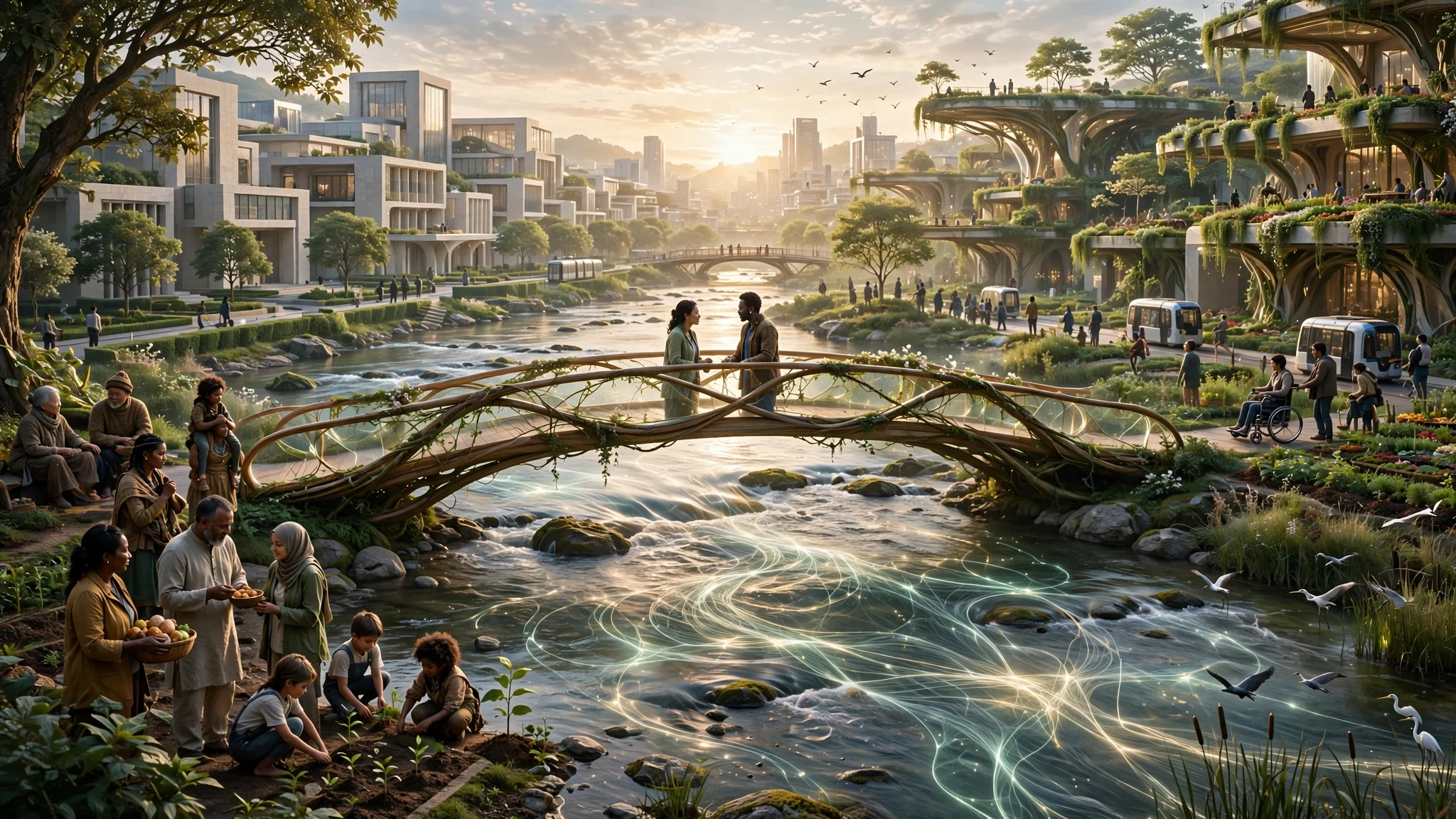
The city had learned, at last, how to disagree.
This was considered a greater achievement than ending war.
War had been easier.
War had required only two words: us and them.
Disagreement was more complicated.
In the year 2048, the cities of the old world had been rebuilt around gardens, waterways and circles of meeting. Concrete towers were wrapped in orchards. Solar glass shimmered above streets where electric trams moved silently beneath flowering trees. Children learned conflict resolution alongside mathematics, and every neighbourhood maintained a House of Listening where anyone could bring a dispute before it became a wound.
The old governments had called these places tribunals.
The people called them hearths.
Because nobody entered a Hearth to win.
They entered to understand what was burning.
Mara lived above the river in a small apartment whose walls opened during the day to let the breeze pass through. Her work was to help communities negotiate difficult decisions. She had a reputation for being good at it.
She could find the sentence that made everyone nod.
She could hear three opposing arguments and discover the hidden truth inside each.
She could take anger and turn it into questions.
She could take fear and translate it into something people could work with.
People trusted her.
People liked her.
People often told her, « You have a gift for making everyone feel heard. »
Mara smiled whenever they said it.
But lately, she had begun to wonder whether being heard was the same as being answered.
The trouble began with the river.
The river had once been declared legally alive. It possessed its own representation in the city council, its interests carried by a rotating group of river guardians who spoke on behalf of the water, the fish, the reeds and the communities downstream.
Now the northern district wanted to redirect part of its flow.
The proposal was reasonable.
That was the problem.
The northern district had suffered three unusually dry summers. Its reservoirs were low. The engineers had designed a beautiful system that would capture winter rainfall, replenish underground aquifers and prevent future shortages.
The southern wetlands objected.
Their argument was equally reasonable.
The wetlands needed the river's seasonal flooding. Without it, thousands of birds would lose nesting grounds, the soil would harden, and the reed beds that filtered the city's water would begin to die.
Both sides had evidence.
Both sides had compassion.
Both sides had experts.
And both sides were certain they were being reasonable.
The council appointed Mara to facilitate the final meeting.
She arrived at the Hall of Waters beneath a ceiling woven from living vines.
Representatives from the northern districts sat opposite the wetland communities. Between them stood a circular table grown from a single ancient oak, its surface polished but still bearing the patterns of the tree's rings.
The first three hours went beautifully.
Mara guided them through the facts.
The engineers explained the reservoirs.
The wetland guardians described the migration patterns.
The farmers spoke about their crops.
The children from the southern marshes displayed recordings of birds whose calls had disappeared from other parts of the country.
Everyone listened.
Everyone nodded.
Everyone used words such as « shared responsibility », « mutual care », « long-term resilience » and « collective wellbeing ».
At the end, Mara stood.
« I think we have made remarkable progress, » she said.
Everyone applauded.
And something inside her went cold.
That night she walked beside the river.
The moonlight lay across the water like a silver road.
She sat beneath a willow and placed her hands against the damp earth.
« What am I missing ? » she whispered.
The river answered in the only language rivers know.
It kept moving.
Mara closed her eyes.
She thought of the meeting.
Of all the careful words.
Of the smiles.
Of the nodding heads.
And suddenly she saw what had been absent.
Nobody had said the thing they were afraid to say.
The northern district did not trust the south.
The southern communities did not trust the engineers.
The engineers were afraid the city would blame them if the reservoirs failed.
The wetland people were afraid that compromise would mean sacrificing their land yet again, as their ancestors had done.
And everyone was afraid that if they spoke those truths aloud, the beautiful peace they had built would crack.
Mara opened her eyes.
The river flowed around the stones.
« Peace, » she said softly, « is not the same thing as quiet. »
The next morning, she cancelled the final vote.
There was an uproar.
Her colleagues asked whether she had lost confidence.
One member of the council said, « We have spent weeks creating consensus. »
« No, » Mara replied. « We have spent weeks creating agreement around everything except the actual disagreement. »
Silence filled the room.
Someone shifted uncomfortably.
The chairperson frowned.
« That sounds unnecessarily confrontational. »
Mara felt the old instinct rise inside her.
Make it softer.
Find another phrase.
Protect everyone from discomfort.
Instead she breathed.
« Perhaps, » she said, « but I think discomfort is trying to tell us something. »
She proposed a new meeting.
No experts.
No presentations.
No prepared statements.
No microphones.
Only the people who lived with the consequences.
They gathered that evening beside the river.
At first, nobody spoke.
Then an elderly farmer from the north stood.
« I am afraid, » she said.
The words sounded almost shocking.
She continued.
« I am afraid that my grandchildren will inherit a city where water is rationed. I am afraid that all our beautiful principles will not matter when the wells are empty. »
A wetland guardian rose.
« I am afraid too, » she said. « I am afraid that every promise of protection will eventually become another excuse to take from us. I am afraid that if we are generous now, our children will pay for it later. »
The engineers spoke next.
They admitted they did not know whether their projections were reliable enough.
The farmers admitted that some of their crops could be changed.
The wetland communities admitted that they had rejected several proposals before fully examining them because they were tired of defending themselves.
One by one, the hidden truths emerged.
Not accusations.
Not weapons.
Truths.
The conversation lasted until midnight.
Then until dawn.
And something strange happened.
Once people stopped pretending they were unafraid, they became less afraid.
The northern farmers offered land for new wetland corridors.
The wetland communities offered seasonal access to certain water channels.
The engineers redesigned the reservoir system around natural flood cycles rather than against them.
Children proposed restoring abandoned canals as living waterways.
Someone suggested removing the lawns from the northern estates and replacing them with food forests.
Someone else suggested harvesting fog from the hills.
By sunrise, there was no perfect solution.
There was something better.
There was a living one.
It would change as the river changed.
The city accepted it.
Not because everyone had won.
Because nobody had been required to lose.
Years later, people would call the River Agreement one of the great achievements of the Renewal.
Mara always corrected them.
« It wasn't the agreement that mattered, » she would say.
« It was the conversation that made the agreement possible. »
The Houses of Listening changed after that.
They stopped measuring success by how quickly disputes ended.
Instead, they asked three questions.
Was everyone able to speak ?
Did everyone have to listen ?
And did anyone say the thing they were afraid would disturb the peace ?
That third question became the most important.
Children learned it first.
At school, when two students argued, the teacher no longer asked, « Who started it ? »
She asked, « What is the truth underneath the argument ? »
In neighbourhood assemblies, whenever people became excessively polite, someone would ring a small bell.
It became known as the Truth Bell.
When it sounded, everyone stopped.
Someone would usually laugh.
Then someone would say something difficult.
And the conversation would begin again.
Years passed.
The city grew greener.
The river cleared.
The wetlands expanded until they reached the edge of the old industrial district, where trees now grew through the foundations of abandoned factories.
Human beings did not become peaceful.
They became better at being human.
They still disagreed.
They still misunderstood one another.
They still became frightened, defensive, stubborn and occasionally foolish.
But they had stopped believing that harmony meant the absence of conflict.
They had discovered that a healthy community was not one in which everyone thought alike.
It was one in which difference could remain present without becoming destruction.
One autumn morning, Mara stood beside the river with a group of children.
One girl pointed towards the water.
« Is the river peaceful ? » she asked.
Mara watched sunlight move across the surface.
« What do you think ? »
The girl considered.
« It doesn't look very peaceful. »
The river was rushing that day, swollen by mountain rain.
« No, » Mara said. « Not in the way people usually mean it. »
« Then how can it be peaceful ? »
Mara smiled.
« Because it doesn't need to pretend to be still. »
The girl looked at the river for a long time.
Then she understood.
The river did not silence the stones.
It did not ask the banks to disappear.
It did not demand that every current move in the same direction.
It simply made room for everything.
And where there was obstruction, it did not become polite.
It moved around it.
Over it.
Through it.
Sometimes, when the obstruction was too great, it gathered strength until the obstruction moved.
Mara took the girl's hand.
Together they walked along the bank.
Behind them, the city awakened.
Doors opened.
Gardens stirred.
Trams hummed.
People began another day of trying to understand one another.
There would be difficult conversations.
There would be mistakes.
There would be moments when someone confused kindness with silence, compromise with surrender, or harmony with avoidance.
But the people had learned something the old world had forgotten.
Truth did not destroy peace.
Truth was the soil in which peace could grow.
And beneath the city's gardens, beneath the homes and roads and gathering places, the ancient river carried the lesson onward.
Not in words.
In movement.
In persistence.
In the endless, patient art of finding a way through.