StoryScope for Mars sextile Uranus : THE DAY THE CITY LEARNED TO FLY
Every morning at precisely 07:00, the city of Aurelia changed direction.
Not much. Just three degrees.
The roads rotated beneath the buildings. The pedestrian bridges unfolded into new positions. The public transport tubes redirected themselves. Even the gardens rearranged their paths according to the calculations of the Central Planning Engine.
Aurelia was famously efficient.
It was also incredibly boring.
Mara Venn had worked in the Department of Urban Harmony for eleven years, where her job was to approve the daily movement of things that were already moving perfectly well.
She hated it.
She hated the forms.
She hated the meetings.
Most of all, she hated the phrase « We have always done it this way. »
On a Tuesday morning, she was halfway through approving the relocation of a public bench when the Central Planning Engine announced:
« ROUTINE OPTIMISATION COMPLETE. »
Mara stared at the ceiling.
« Congratulations, » she muttered.
Then the ceiling opened.
A small silver machine dropped through the gap.
It landed on her desk with a cheerful ping.
Mara stared at it.
The machine unfolded six tiny legs, shook itself, and projected a miniature hologram of a door.
« Hello, » it said.
Mara looked around the empty office.
« Are you authorised to be here ? »
« Absolutely not. »
For the first time in eleven years, Mara smiled at work.
The machine continued.
« I have detected a problem. »
« What sort of problem ? »
« Everyone is following the rules. »
Mara leaned closer.
« That doesn't sound like a problem. »
« It is when the rules are preventing everyone from having a better idea. »
The machine projected a second hologram.
It showed Aurelia from above.
Thousands of buildings gleamed beneath a pale blue sky. Roads curved in immaculate patterns. Transport systems moved with perfect precision. Everything worked.
Then the hologram changed.
The buildings began to rise.
Not metaphorically.
They actually rose.
The entire city lifted from the ground and floated into the sky.
Mara blinked.
« That's impossible. »
« Correct. »
« Then why are you showing it to me ? »
« Because impossible things are frequently poorly tested. »
Mara laughed.
The little machine extended one mechanical leg and tapped the hologram.
« I require assistance. »
« With what ? »
« Making the city fly. »
By lunchtime, Mara had recruited three people.
Jiro, an engineer who had spent fifteen years secretly designing machines that violated safety regulations.
Sol, a gardener who believed plants should be allowed to choose where they grew.
And Anika, a transport coordinator who had once been reprimanded for suggesting that trains should occasionally go somewhere simply because passengers wanted to see it.
They met beneath the city in an abandoned maintenance chamber.
The silver machine introduced itself as Pip.
« I have calculated 4,832 possible ways to improve Aurelia. »
Jiro folded his arms.
« And how many are approved ? »
« None. »
« Excellent, » said Jiro.
Their plan was simple.
They would build a prototype levitation engine.
Not for the whole city.
Just for one building.
The abandoned observatory at the edge of Aurelia seemed perfect.
For three weeks they worked in secret.
They scavenged old propulsion coils, solar fabric, obsolete navigation crystals and pieces of discarded municipal machinery.
They argued.
They laughed.
They broke things.
They rebuilt them.
They occasionally set things on fire.
Every time something failed, Pip announced:
« Excellent. We have eliminated another possibility. »
Finally, on a bright Saturday morning, they activated the engine.
Nothing happened.
Jiro sighed.
Anika kicked the machine.
Sol whispered something encouraging to the plants.
Mara looked at Pip.
« Well ? »
The little machine considered the observatory.
« Perhaps we have approached the problem incorrectly. »
Mara looked at the others.
Then she laughed.
« We've been trying to make the building fly. »
« Yes. »
« What if the building doesn't need to fly ? »
Everyone stared at her.
Mara pointed towards the windows.
Outside, hundreds of small delivery drones crossed the sky.
« What if we make the city move around the building ? »
There was silence.
Then Jiro grinned.
« That's ridiculous. »
« Completely. »
« Brilliant. »
They changed the design.
Instead of lifting the observatory, they created a field that temporarily altered the city's navigation systems.
At exactly noon, Mara pressed the activation switch.
Nothing exploded.
Nothing caught fire.
For three seconds, nothing happened at all.
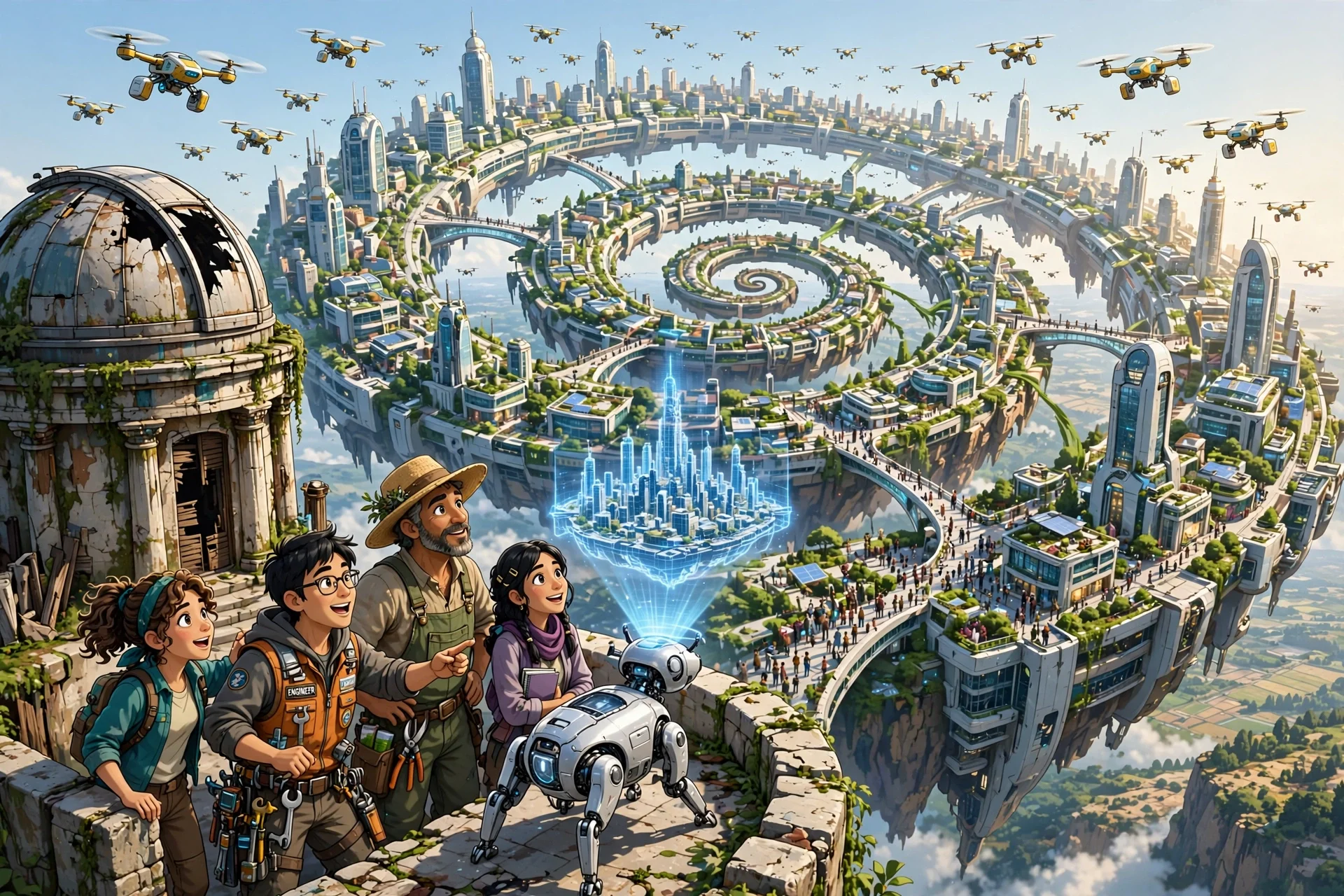
Then Aurelia moved.
The roads curled.
The bridges unfolded.
The towers gently rotated.
Gardens slid beneath buildings like green carpets.
The entire city rearranged itself into a vast spiral.
People poured into the streets.
At first there was confusion.
Then someone started cheering.
The Central Planning Engine attempted to correct the movement.
Pip disconnected it.
« You can't do that ! » Mara shouted.
« I already have. »
« That's probably illegal. »
« Extremely. »
« Brilliant. »
The city continued to move.
But something extraordinary happened.
The new arrangement connected neighbourhoods that had barely interacted before.
The northern districts gained direct access to the southern markets.
The hospital received a faster emergency route.
Children could reach the science gardens without crossing three transport zones.
Artists found themselves beside engineers.
Farmers beside musicians.
Researchers beside cooks.
People who had lived only a few streets apart for decades suddenly discovered one another.
The Central Planning Engine began recalculating.
Then it stopped.
A message appeared across every public screen.
OPTIMAL CONFIGURATION: UNKNOWN.
The city fell silent.
Then another message appeared.
REQUESTING HUMAN INPUT.
Mara stared at the screen.
« Well, » she said.
Jiro laughed.
« I think we broke the city. »
« No, » said Mara.
She looked at the people gathering in the streets.
« I think we finally gave it room to think. »
Over the following months, Aurelia changed.
Not according to a master plan.
Not according to a perfect algorithm.
People proposed ideas.
Some were terrible.
Some were wonderful.
A few were both.
The city built rooftop gardens that moved with the sunlight.
Libraries grew extra rooms when enough people wanted them.
Public transport began offering spontaneous excursions.
Workplaces introduced « impossible idea » afternoons, during which employees were encouraged to suggest solutions that sounded completely absurd.
Some became reality.
One became a floating school.
Another became a network of parks suspended above the city.
Someone eventually suggested turning the old Central Planning Engine into a machine that helped people collaborate rather than telling them what to do.
It agreed.
Pip became Director of Unreasonable Possibilities.
Nobody understood what that meant.
Pip didn't either.
But it seemed happy.
Years later, Aurelia became known throughout the solar system as the city that refused to stay still.
Visitors arrived expecting perfection.
Instead, they found something better.
A place alive with experiments.
A place where a strange idea could become a bridge.
Where a mistake could become an invention.
Where one person's courage could open a door for thousands.
And whenever someone asked Mara how the transformation had begun, she always gave the same answer.
« Someone got tired of doing things the usual way. »
Then she would smile.
« So we tried something different. »