
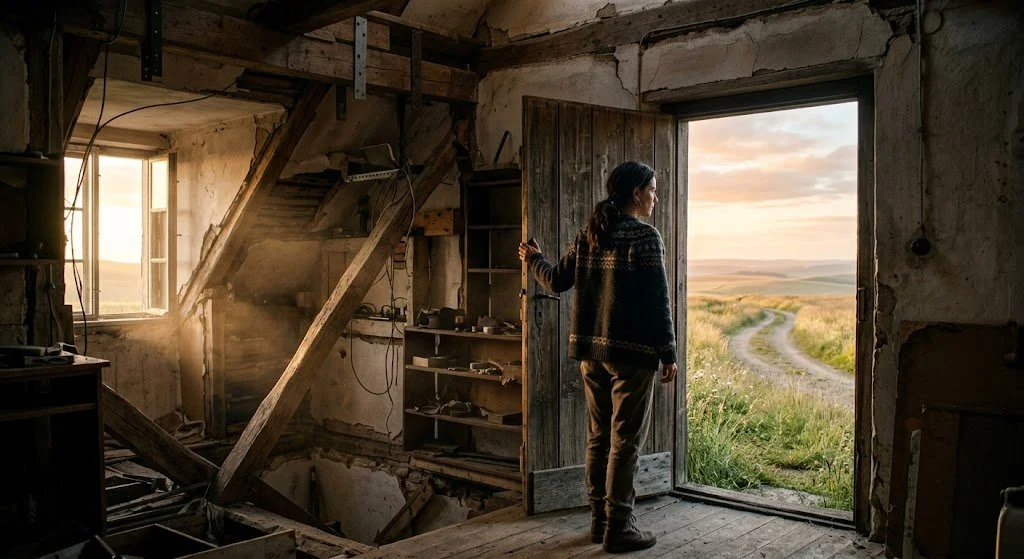
By Monday morning, Mara noticed that the house had begun to sigh.
It was not the ordinary settling of old timber or the groan of pipes warming beneath the floors. This was something deeper. A long, exhausted exhalation that travelled through the walls and disappeared beneath the foundations.
She stood in the kitchen with a cup of coffee in her hand and listened.
«Old houses make noises,» she told herself.
The house sighed again.
«It’s nothing.»
She had become very good at saying that.
For seven years, Mara had lived in the house on the hill, and for seven years she had been repairing things.
A crack appeared in the ceiling, and she painted over it.
A door stopped closing properly, and she shaved a little wood from its edge.
The eastern balcony began to lean, so she installed a brace beneath it.
When rain came through the roof, she placed a bucket underneath and called the problem temporary.
Everything was temporary.
The strange thing was that the temporary repairs had accumulated until they had become the house itself.
There were beams holding up beams, cables holding up beams, brackets holding up cables. There were ingenious solutions to problems created by previous ingenious solutions.
Mara was proud of them.
She had learned how to keep things functioning.
That was different from making them work.
On Monday afternoon, while standing beneath the staircase, she suddenly saw it.
The staircase was not the problem.
Neither was the balcony.
Neither was the cracked ceiling.
She followed the lines of pressure through the walls with her eyes and understood, all at once, that the entire upper floor was leaning on one small section of foundation that had been compromised years ago.
The house had been warning her.
She had simply been repairing the warnings.
Mara laughed.
It was the kind of laugh that comes when an impossible puzzle finally becomes obvious.
«Oh,» she whispered.
For the first time in years, she knew exactly what was wrong.
She also knew what would have to change.
And that frightened her considerably more.
Tuesday brought a visitor.
His name was Julian, and he arrived carrying flowers.
Mara almost smiled when she saw them.
«How thoughtful.»
«I know you’ve had a difficult week.»
He stepped inside without waiting to be invited.
Julian had a talent for appearing generous while somehow making generosity feel like a debt.
He had once told Mara that he loved her independence.
Later, he had explained which decisions he thought she should make.
He had once said he trusted her completely.
Later, he had wanted to know where she was, who she was with, and why she had taken so long to answer.
He had lent her money when she was struggling.
Eventually, every argument became about the money.
He had been wounded by her distance.
She had been wounded by his expectations.
They had spent years confusing emotional intensity with intimacy.
That afternoon, Julian placed the flowers in a vase.
«I thought we could talk.»
Mara nodded.
«About what ?»
«About us.»
The house creaked overhead.
Julian looked up.
«You really should get someone to fix this place.»
Mara almost laughed.
Instead, she asked, «Do you want me to change something ?»
«I want things to be better.»
«That wasn’t what I asked.»
He stared at her.
«I want you to stop making everything so difficult.»
There it was.
The bargain.
Mara felt it settle between them like another beam across the ceiling.
She realised that control rarely announced itself as control.
It arrived disguised as concern.
As love.
As disappointment.
As sacrifice.
As a reasonable request made by someone who had supposedly given so much.
«What do you need from me ?» she asked.
Julian smiled.
«I just need you to meet me halfway.»
«And what does halfway look like ?»
He began explaining.
For the first time, Mara listened without trying to make his explanation reasonable.
She heard the conditions.
The expectations.
The invisible permissions.
The things she would have to surrender in exchange for peace.
When he finished, she said quietly, «That isn’t halfway.»
His expression changed.
«Then what is it ?»
«You tell me.»
Julian left without taking the flowers.
By evening, they had turned black.
On Wednesday, Mara did nothing.
This was surprisingly difficult.
She did not repair the house.
She did not call Julian.
She did not make lists.
She did not try to understand everyone else's feelings.
She sat in the garden and watched the wind move through the long grass.
For years she had mistaken constant activity for courage.
Perhaps courage was sometimes the ability to stop.
On Thursday, the house showed her something.
Mara woke before dawn and found herself standing in the hallway.
A door had appeared where there had never been a door before.
It was small, painted white, with a brass handle.
She opened it.
Inside was the room she had been avoiding for most of her life.
It contained no monsters.
No ghosts.
Only a little girl sitting on the floor.
Mara recognised her immediately.
The child looked up.
«You’re late.»
Mara sat beside her.
«I know.»
«Are we in trouble ?»
«No.»
The girl considered this.
«Are you sure ?»
Mara looked at her.
The child's knees were drawn against her chest. Her shoulders were small. Her eyes had the wary intelligence of someone who had learned very early that occupying too much space could have consequences.
Mara remembered all the things she had learned from being afraid.
Be agreeable.
Don't make things worse.
Wait.
Be useful.
Don't anger anyone.
Don't need too much.
Don't ask for too much.
Don't leave.
Don't stay.
Make yourself smaller.
Make yourself indispensable.
Call it kindness.
Call it patience.
Call it love.
Mara reached for the child's hand.
«You don't have to ask permission anymore.»
The girl looked suspicious.
«From whom ?»
Mara thought about it.
«Everyone.»
The little girl frowned.
«That doesn't sound safe.»
«No,» Mara said. «It doesn't.»
She squeezed her hand.
«But safe and small aren't the same thing.»
The room disappeared.
Mara found herself back in the hallway.
The house had stopped sighing.
Instead, something beneath the floor gave a deep, decisive crack.
She ran downstairs.
The foundation had split.
For a moment, terror took over.
Then she saw something else.
The crack had exposed the original foundation beneath all the repairs.
It was not as strong as she had believed.
But neither was it as fragile.
The house had not needed another brace.
It needed the weight redistributed.
Some walls would have to come down.
Some rooms would have to change.
Some things she had spent years protecting would have to be removed entirely.
Mara stood there until she began to laugh.
«All right,» she said.
The house remained silent.
«Let’s stop pretending.»
On Friday, Julian returned.
He did not bring flowers.
«I think we need to decide what we're doing,» he said.
Mara invited him inside.
They sat at the kitchen table.
For once, she did not soften the truth before speaking it.
«I don't want this relationship in its current form.»
Julian looked wounded.
«So that's it ?»
«No. That's the beginning of the conversation.»
He leaned back.
«What do you want ?»
Mara took a breath.
«I want a relationship where care isn't a bargaining chip. Where money isn't a weapon. Where silence isn't punishment. Where vulnerability isn't used to control the other person. Where neither of us has to become smaller to keep the peace.»
Julian looked at her for a long time.
«And if I can't give you that ?»
Mara looked towards the cracked window.
Morning light was coming through.
«Then I need to know what happens if nothing changes.»
He said nothing.
Neither did she.
For once, silence was not punishment.
It was an answer waiting to be heard.
On Sunday, Mara removed the first supporting beam.
She had been warned not to.
Everyone said it was reckless.
Everyone had an opinion about which wall should remain, which relationship should be preserved, which agreement should be honoured, which compromise should be tolerated for another year.
Mara listened.
Then she made her own decision.
The beam came down.
The house shuddered.
Dust filled the air.
For several terrible seconds, she thought the whole structure would collapse.
Then something extraordinary happened.
The house settled.
Not perfectly.
Not beautifully.
But honestly.
A wall that had been carrying too much weight was finally free of it.
A window that had been permanently jammed opened.
Sunlight entered a room that had been dark for years.
Behind the old wall, Mara discovered a narrow passage leading outside.
She had never seen it before.
At the end of the passage stood a door.
Beyond it was a road.
Not the road she had planned.
Not the road anyone had promised would be safe.
Just a road.
Open.
Unfamiliar.
Possible.
Mara stood at the threshold.
Behind her was the house she had spent years trying to save.
Ahead was a life she had not yet built.
She realised then that she did not need to destroy the past to move forward.
She only needed to stop carrying it.
So she stepped outside.
The house did not collapse.
It stood behind her, wounded but breathing, no longer pretending to be something it was not.
And for the first time, Mara understood the difference between postponing a decision and making one.
A decision did not always solve the problem.
Sometimes it simply stopped the lie.
Sometimes that was where the real repair began.