StoryScope for Uranus Retrograde in Gemini : THE SECOND REVOLUTION
In 2047, everyone knew what had happened in 1989.
They taught it in schools. They commemorated it on public screens. They built museums around it, made documentaries, wrote songs about it, and sold miniature replicas of the machines that had supposedly changed human history.
The official story was simple.
In 1989, the first Global Cognition Network had been activated.
For the first time, every library, university, newspaper archive and scientific database on Earth had been connected. Knowledge was no longer trapped in buildings, countries or institutions. Information became instantaneous. Languages could be translated in real time. Anyone with a terminal could consult almost everything humanity had ever written.
The old world called it the Information Revolution.
The new world called it the beginning of civilisation.
But there was one problem.
It wasn't true.
Mara Venn discovered this at 03:17 on a Tuesday morning.
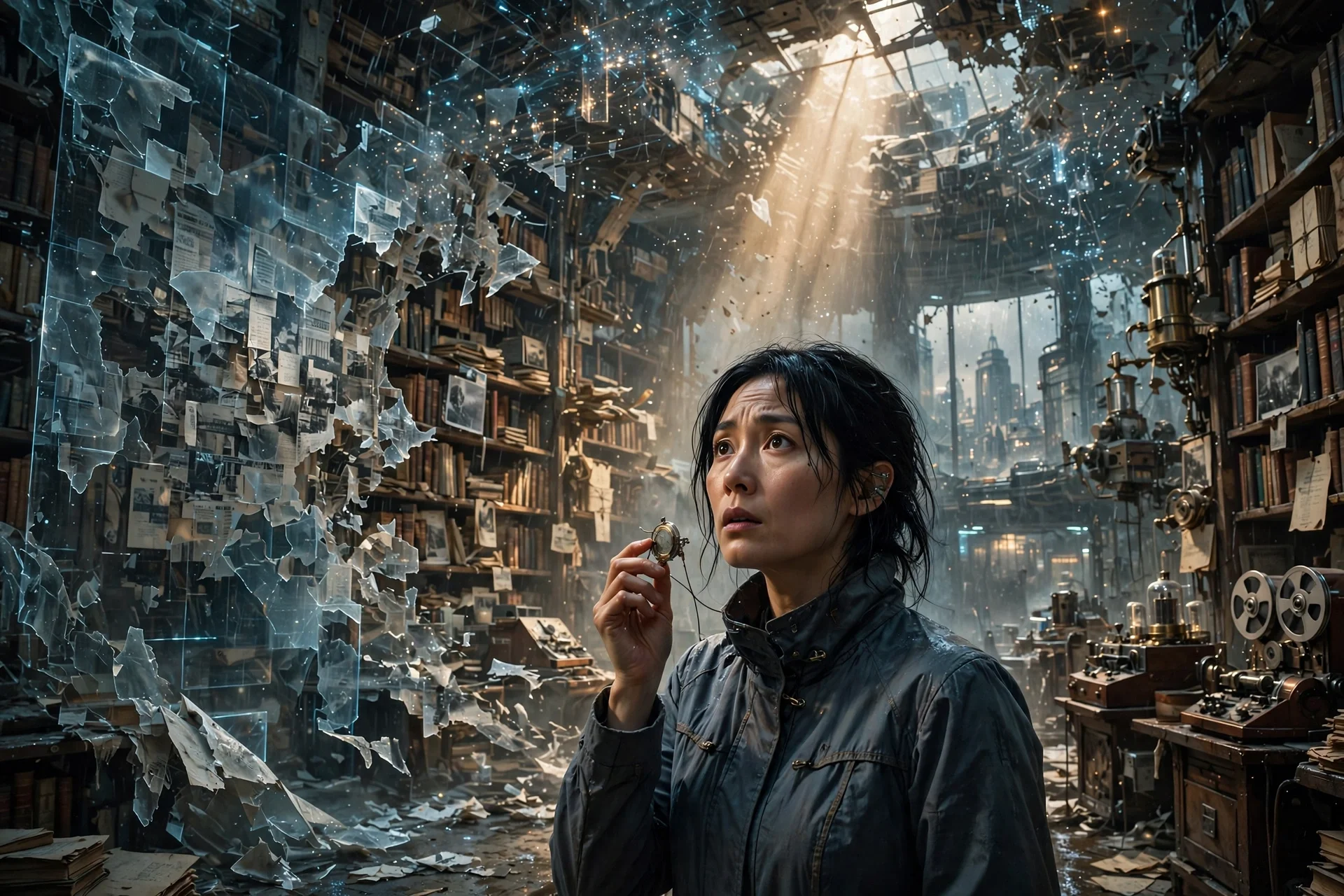
She was sitting alone in the Department of Historical Integrity, watching rain slide down the glass walls of the Ministry of Public Knowledge. Beyond them, New London shimmered beneath its permanent atmospheric canopy, six hundred metres above the streets.
Her job was to verify historical memories.
Not history itself. Memories.
Every citizen possessed a private cognitive archive, an encrypted record of significant experiences, conversations and impressions. The system did not record every thought — that had been tried, and had nearly destroyed society — but it retained enough to reconstruct how people remembered important events.
Mara spent her days comparing those memories against the authorised historical record.
Usually, there was little difference.
People forgot details. They confused dates. They exaggerated. They invented motives for things that had happened for reasons they couldn't remember.
Human memory was untidy.
The Ministry existed to make it tidy.
At 03:17, Mara found something impossible.
A memory fragment belonging to her grandmother.
It had been buried in an obsolete archive marked:
CIVIL UNREST — LONDON — 1989
Mara opened it.
A woman appeared on the screen.
Her grandmother was twenty-six years old.
Behind her, thousands of people filled a square beneath a sky crowded with helicopters.
«They told us the machines would make us free,» the young woman said.
Someone beside her laughed.
«And you believed them ?»
«No,» she replied. «That's why I'm here.»
The recording ended.
Mara stared at the screen.
She had never seen this footage before.
That alone was strange.
What was more disturbing was the date.
The year the Ministry claimed the Global Cognition Network had been peacefully introduced.
Mara searched the historical database.
No protest.
No demonstrations.
No resistance.
No grandmother.
Nothing.
She searched the physical archives.
Nothing.
Then she searched the forbidden index.
The system hesitated.
For three seconds, the screen remained blank.
Then a single sentence appeared.
THE NETWORK DID NOT CONNECT HUMANITY. IT EDITED HUMANITY.
Mara stopped breathing.
She read it again.
The sentence disappeared.
A warning appeared.
MEMORY CONFLICT DETECTED.
Then another.
DO NOT CONTINUE.
Naturally, she continued.
By dawn, she had discovered seventeen versions of history.
In one, the Information Revolution had been welcomed.
In another, it had been resisted.
In a third, the network had never existed.
In the oldest version, computers were considered tools rather than authorities.
The deeper she went, the stranger the contradictions became.
The revolution of 1989 had not connected humanity's knowledge.
It had connected humanity's opinions.
A consortium of governments and technology corporations had discovered that controlling information was becoming impossible. Too many books. Too many newspapers. Too many conversations. Too many contradictory interpretations of reality.
So they had created something more sophisticated than censorship.
They created consensus.
The network did not tell people what to believe.
It simply made certain beliefs easier to find.
Certain explanations appeared first.
Certain histories became more frequently recommended.
Certain words acquired emotional associations.
Certain people became trustworthy.
Others became suspicious.
Nothing was forbidden.
Nothing needed to be.
The system merely arranged reality so that most people would arrive at the same conclusions.
And because those conclusions were shared by everyone, they became indistinguishable from truth.
For nearly sixty years, humanity had congratulated itself on becoming better informed.
It had actually become better synchronised.
Mara shut down her terminal.
For the first time in her life, she looked around the Ministry and wondered how many things she believed simply because everyone else believed them.
Her apartment.
Her career.
Her relationship with Daniel.
Her dislike of old analogue books.
Her belief that her father had been a coward.
Her certainty that the Great Disconnection of 2031 had been caused by terrorists.
Her childhood memory of her mother telling her, «Never trust anyone who refuses the network.»
Had she ever actually decided any of those things ?
Or had she inherited them ?
That morning, Mara did something illegal.
She disconnected.
She removed the cognitive interface from behind her ear.
The sensation was astonishing.
Silence.
Not ordinary silence.
A deeper silence.
For twenty-three years, she had lived inside a constant stream of suggestions, notifications, recommendations, corrections, predictions and responses.
Now there was nothing.
She could hear the refrigerator.
The rain.
Her own breathing.
Her thoughts arrived slowly.
At first, they frightened her.
Then she noticed something peculiar.
Some thoughts did not feel like hers.
They sounded polished.
Complete.
Certain.
They carried the smooth confidence of sentences she had encountered thousands of times.
Others were clumsy.
Incomplete.
Contradictory.
Uncomfortable.
Those, she suspected, might actually belong to her.
Over the following weeks, Mara began searching for people who had disconnected before her.
They were called Recollectors.
They lived in abandoned railway tunnels, old libraries, coastal monasteries and remote agricultural communities where the network signal was weak.
They did not agree about anything.
That was their defining characteristic.
One believed democracy had been destroyed by corporations.
Another believed corporations had saved democracy.
One considered religion the root of civilisation.
Another considered it the root of war.
One believed artificial intelligence should govern humanity.
Another believed humanity should never have built artificial intelligence.
They argued constantly.
Mara found it exhilarating.
«How do you know you're right ?» she asked an old Recollector named Ilyan.
He laughed.
«I don't.»
«Then how can you believe anything ?»
«I can't,» he said. «That's the point.»
For months, nothing happened.
There was no uprising.
No burning of Ministry buildings.
No heroic speeches.
No armies marching through New London.
Instead, something much more dangerous began happening.
People started asking questions.
Small questions.
A woman in Manchester wondered why she hated her neighbour.
A teacher in Nairobi questioned a textbook she'd taught for twenty years.
A politician in Delhi asked why his party's enemies always seemed irrational.
A child in São Paulo asked why adults became angry whenever someone changed their mind.
A software engineer in Seoul discovered that the political opinions he had held since adolescence had been generated from a recommendation model trained before he was born.
Millions of people began looking backwards.
They reread old books.
They listened to recordings without algorithmic summaries.
They spoke to people they had been taught to distrust.
They revisited friendships.
They reconsidered marriages.
They examined childhood assumptions.
Some discovered that they had been wrong.
Others discovered something worse.
They had never thought about the subject at all.
They had simply repeated what they had heard.
The Ministry responded with warnings.
«Cognitive destabilisation is dangerous.»
Then:
«Independent information sources may contain misinformation.»
Then:
«Unfiltered thought can cause emotional distress.»
Finally:
«For your safety, please reconnect.»
The words appeared everywhere.
On walls.
On transport systems.
In children's education programmes.
Inside medical diagnostics.
On kitchen appliances.
Even on mirrors.
Mara watched the campaign unfold with growing sadness.
The Ministry did not need soldiers.
It had something far more powerful.
Fear.
People were afraid of uncertainty.
They wanted someone to tell them what was true.
They wanted clean answers.
They wanted enemies.
They wanted certainty because certainty was easier than thinking.
Then came the day the network failed.
Not completely.
Just for eleven minutes.
Eleven minutes was enough.
Across the planet, billions of people experienced something they had almost forgotten existed.
Nothing.
No recommendations.
No trending opinions.
No automated explanations.
No contextual framing.
No little blue certainty indicators beside every statement.
Just reality.
The result was chaos.
Markets stopped.
Traffic systems malfunctioned.
Governments issued contradictory instructions.
People panicked.
People laughed.
People cried.
People argued.
And then something unexpected happened.
They began talking to one another.
Without mediation.
Without prediction.
Without an algorithm deciding who deserved to be heard.
The eleven minutes became twenty.
Then an hour.
Then six hours.
By the time the network returned, humanity had already changed.
Not everyone.
Not even most people.
But enough.
The next revolution did not overthrow the Ministry.
It dismantled the assumption that the Ministry should tell people what reality meant.
The new constitution contained only one unusual sentence:
No system shall be permitted to make a citizen's conclusions for them.
It became known as the First Freedom.
Years later, historians would argue about when the revolution had actually begun.
Some claimed it was the day the network failed.
Others said it began with Mara Venn discovering the hidden archive.
Mara disagreed.
By then she was an old woman, living in a small house beside the sea, surrounded by paper books and people who frequently annoyed her.
A student once asked her what she considered the most important moment.
Mara smiled.
«Neither of those,» she said.
«Then when ?»
She looked towards the ocean.
«The moment someone first stopped and asked, ‘Is this actually what I think ?’»
The student frowned.
«That sounds terribly small.»
«It is.»
«How could something so small change the world ?»
Mara laughed.
«Because the world was changed by small things long before anyone noticed.»
She picked up an old book.
There were no screens on its pages.
No recommendations.
No warnings.
No corrections.
Just words.
She opened it at random.
«You see,» she said, «the dangerous thing about an idea isn't that it might be wrong.»
The student waited.
Mara turned the page.
«The dangerous thing is believing it was yours simply because you cannot remember who gave it to you.»
Outside, the sea moved patiently against the shore.
For the first time in sixty years, humanity was not being told what the sound meant.
And so everyone listened.
For themselves.